
Diverter Valves
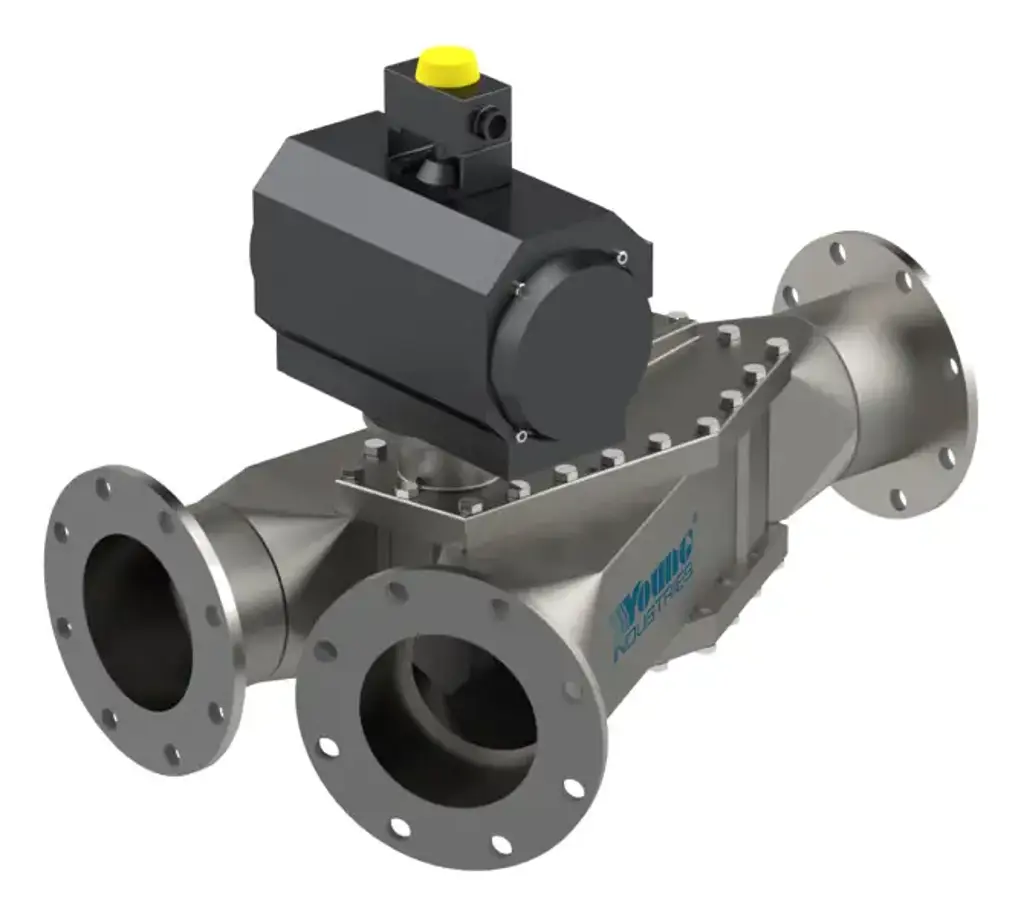
Young Industries’ diverter valves are built on over 75 years of experience and design expertise, delivering the performance you need to keep your operation running smoothly.
Our valves distinguish themselves through a reduced total cost of ownership, thanks to expert engineering and durable construction that minimize maintenance and downtime. They are designed for a longer service life, utilizing high-quality materials that ensure reliable performance even in challenging conditions. With industry-leading low leakage, our valves help minimize product loss and maintain process integrity. Additionally, they are manufactured with precision using the latest techniques, reflecting our commitment to modern manufacturing practices.
In critical bulk material handling applications, the integrity of your material flow directly impacts your bottom line. Our robust diverter valves provide reliable redirection for pneumatic conveying systems, enabling seamless transitions between destinations, accurate batching, and efficient process control. Whether you’re handling powders, pellets, or granules, our designs prioritize material compatibility and minimize wear, ensuring your system performs consistently day in and day out.
We understand that every operation has unique demands. That’s why Young Industries offers a range of diverter valves tailored to specific needs, including specialized options for abrasive materials, high temperatures, or unique system layouts. Our commitment to real-world experience means we deliver solutions that are not just theoretically sound but proven to perform where it counts—on your plant floor. From the rugged construction of our cast bodies to precision-machined sealing surfaces, every detail is engineered for maximum uptime and superior operational efficiency.

Model B Diverter
Young Industries' Model B Swing Gate Diverter Valve ensures reliable, leak-free material routing in pneumatic conveying systems.
Learn More
Model C Diverter
Minimize leakage and maximize efficiency with Young Industries' Model C Symmetrical Swing Gate Diverter Valve.
Learn More
Model TDV Diverter
Precisely control gravity flow with Young Industries' Tab/Blade Diverter Valves. Customizable for your specific needs.
Learn More
Model VT Diverter
Control gravity flow bulk materials with Young Industries' Rotary Vane Diverter Valves. Minimize leakage and downtime.
Learn More
Model TU Diverter
Young Industries' Rotary Plug Diverter Valves: Ideal for pneumatic and gravity flow applications, with customizable options available.
Learn More
Model BDV Diverter
Efficiently divert gravity flow bulk materials with Young Industries' Bucket Diverter Valves.
Learn MoreFAQs
Think of a diverter valve as the traffic controller for your production line. Its primary job is to direct the flow of dry bulk material from one point to another. It can be used to route material from a single source to multiple destinations (like different storage silos or packaging lines) or to combine materials from several sources into a single line.
Essentially, it provides the critical ability to change the path of your material without stopping your process, which is fundamental to creating a flexible and efficient system.
In a pneumatic conveying system, a diverter valve works by creating a sealed, pressure-tight path to redirect material moving in an air stream. An actuator (either electric, pneumatic, or manual) moves an internal mechanism, typically a pivoting flap or a rotating plug, to close off one port while opening another.
The key is that this happens within a rugged, sealed housing. A positive seal is crucial to prevent loss of pressure, which would hurt your conveying efficiency, and to stop material from leaking into the wrong line, which causes cross-contamination.
This is where real-world engineering and experience come into play, because “standard” valves often fail in these harsh conditions.
For Abrasive Materials: You can’t use standard materials of construction. The best choice is a valve designed explicitly for abrasion resistance. This often involves using hardened materials for all surfaces that come into contact with the material flow. We frequently engineer valves with features like a tungsten carbide coating on the blade or housing, which provides exceptional abrasion resistance and dramatically extends the life of the valve.
For High Temperatures: You need a valve built with specialized materials that can handle the heat without warping or failing. This includes using high-temperature metal alloys for the body and blade, as well as seals and bearings rated for the specific operating temperature. Often, the design itself is modified, for instance, by using stand-offs to move the actuator away from the hot valve body.
For both scenarios, the answer isn’t off-the-shelf; it’s a custom-engineered solution built for the specific challenge.
This is a question we’re passionate about, because it gets to the core of innovative system design. The number one way to reduce maintenance and downtime is to select the correct valve for the application from the start. A valve that is undersized or not built for your specific material will always cause problems.
Beyond that, look for valves with robust, heavy-duty construction. Features like externally replaceable seals are also a considerable advantage, as they allow for maintenance without taking the valve completely out of service. Ultimately, investing in a quality, correctly specified valve will always pay for itself through increased uptime and a lower total cost of ownership.
The difference is all about the application.
Gravity Diverter Valves are used in systems where material is moved by gravity alone—think of it falling out of the bottom of a silo or hopper. They typically use a simple flapper to direct the stream of material. They are not designed to hold pressure.
Pneumatic Diverter Valves are designed specifically for pneumatic conveying lines where material is moving in a pressurized or vacuum air stream. They must be built to be pressure-tight to maintain the integrity and efficiency of the conveying system. Using a gravity diverter in a pneumatic line would result in significant pressure loss and leakage.
Leakage prevention comes down to two things: design and materials. A well-designed valve features precision-machined internal surfaces that allow the diverting mechanism to create a tight closure. The real key, however, is the seal. High-quality elastomer seals that are energized against the blade or plug provide a positive seal, preventing material from leaking to the closed-off port. This is absolutely critical for preventing cross-contamination between product lines.
That’s the million-dollar question, and the honest answer is: it depends entirely on the application. A valve handling a non-abrasive material at ambient temperature on a low cycle frequency could last for many, many years. A valve in a highly abrasive, high-temperature, high-cycle application might have a lifespan measured in months if not properly designed.
The lifespan is directly tied to the quality of the valve and how well it was specified for the job. A robust, heavy-duty valve with the right materials of construction (like abrasion-resistant coatings) will always outlast a standard valve in a demanding environment.
With the right design and construction, a diverter valve can handle nearly any dry bulk solid. Over our 70+ years, we’ve engineered diverter valves for a vast range of materials, including:
- Fine, cohesive powders: Pigments, cement, talc, carbon black
- Granulars and pellets: Plastic pellets, coffee beans, salt, sugar
- Abrasives: Sand, alumina, furnace dust, minerals
- Food products: Flour, spices, grains
The key is understanding the material’s characteristics first, like its abrasiveness, cohesiveness, and particle size, and then selecting the valve to match.
While there are many custom designs, most diverter valves fall into a few main categories:
Flap Diverters: These use a single, pivoting blade or “flapper” to close off one port and open another. They are very common and effective for a wide range of applications.
Plug Diverters: These use a rotating cylindrical or tapered plug with a bore through it. The plug rotates to align the bore with the desired outlet ports. They are excellent for providing a positive seal, making them ideal for fine powders.
Slide Gate Diverters: These use a sliding plate to shut off flow to one or more ports.
Choosing the right diverter valve is a critical decision. When we work with a customer, we walk through a comprehensive checklist to make sure we get it right. Here are the key factors you should always consider:
- Material Characteristics: What is its particle size, bulk density, abrasiveness, and cohesiveness?
- Operating Conditions: What are the system’s pressure, temperature, and humidity levels?
- Application Requirements: How many ports are needed? What is the required cycle frequency?
- Materials of Construction: Do you need stainless steel for food/pharma, or special coatings for abrasion or corrosion resistance?
- Sealing Requirements: How critical is preventing cross-contamination?
- Actuation: Will you use a pneumatic, electric, or manual actuator?
- Certifications: Do you need equipment that meets standards like NFPA for combustible dust hazards?
Considering these factors upfront is the best way to ensure you get a valve that will provide years of reliable service. The first step is always a conversation with an experienced engineer who understands these variables.

